How to choose and use drip irrigation tape
Currently, drip irrigation tape is in the peak sales season. In order to prevent fake and inferior drip irrigation tape from harming farmers, safeguard the rights and interests of farmers and consumers, and ensure the smooth progress of agricultural production, the following popular science tips on drip irrigation tape are hereby released.
Currently, drip irrigation tape is in the peak sales season. In order to prevent fake and inferior drip irrigation tape from harming farmers, safeguard the rights and interests of farmers and consumers, and ensure the smooth progress of agricultural production, the following popular science tips on drip irrigation tape are hereby released.
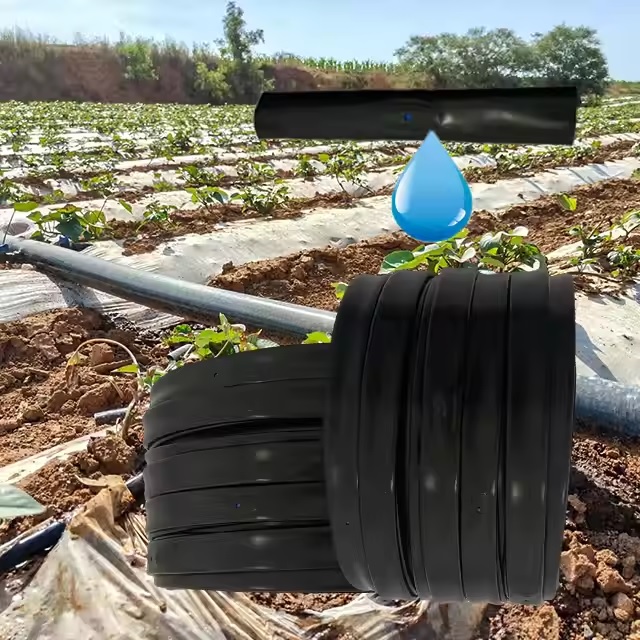
一. How to judge the quality of drip irrigation tape
First, check whether the drip irrigation tape has a certificate of conformity, instructions for use, and specification model labels, and then select high-quality drip irrigation tape by "looking at three points in appearance and checking six indicators".
Look at three points in appearance. First, look at the color, which is generally black. Use the light of a mobile phone to illuminate the inner tube to observe whether the light transmittance is uniform and consistent; second, look at the surface, which is smooth and flat, without bubbles, hanging line deflection blocks, impurities, etc. Third, look at the maze flow channel, which is full and has no deformation.
There are six indicators to be tested. The first is the dripper flow rate. In our area, the dripper flow rate should be 1.8-2.6L/h. The second is the dripper spacing. Taking the corn spacing as an example: generally 200-250mm is appropriate (20-25 cm). It is difficult to ensure the uniformity of the general flow below 200mm. The larger the spacing, the larger the drip hole. The third is the flow uniformity coefficient. The flow uniformity coefficient (CV) should be less than 7%. The fourth is the anti-clogging performance. The anti-clogging performance mainly depends on the flow channel structure, size and water flow velocity in the flow channel of the emitter. The zigzag flow channel structure is better than the Great Wall type maze flow channel. The pre-filter tank can improve its performance. The fifth is the tensile performance. The tensile performance is often related to the proportion of new materials. The more new materials, the better the tensile performance. The drip irrigation belt produced entirely with recycled materials generally has unqualified tensile performance. The sixth is the anti-aging performance. The anti-aging performance is to ensure the service life of the drip irrigation belt. It mainly depends on whether an appropriate amount of high-quality carbon black and antioxidants are added. The standard requirement for carbon black content is 2.25±0.5%.
二. Precautions for purchasing drip irrigation tape
1. Choose regular channels to purchase drip irrigation tape and keep the sales receipts; when purchasing products, pay attention to the name of the manufacturer, production address and product information, especially avoid purchasing "three no" products and products with prices significantly lower than the normal range;
2. If you purchase "three no" products or products with quality problems, please complain to the local quality supervision department in time;
3. When purchasing, first touch it with your hands to understand the thickness, solidity and other quality issues of the drip irrigation tape, and then cut a dozen meters long sections from different packages, directly connect them to the drip irrigation faucet, add water and pressure to test drip.
4. Before purchasing drip irrigation tape, you must first sign a formal contract to ensure the quality of the product. The contract must contain the content of the three guarantees of quality (return, replacement, and repair), as well as what kind of responsibilities should be borne after breach of contract.
三,Drip irrigation tape laying and installation method
1. The plot where the drip irrigation equipment is installed should be finely ground and the roots should be picked clean. Roots, stones, weeds and other objects can easily pierce the drip irrigation tape and lift up the ground film, causing water vapor to accumulate in the ground film, forming a lens effect.
2. During installation, the staff should carefully read the instructions for use of each component and connect the components using the correct installation method.
3. When laying the drip irrigation tape, keep the labyrinth side facing up and lay it flat under the film. Do not lay it upside down or twist it.
4. Once the trunk, branch and attached pipes are installed, agricultural machinery and farm tools must be strictly prohibited from rolling or scraping the pipes to avoid external damage and reduce the service life.
5. If mechanical laying is used, the pulley and the rotating mechanism must be equipped with bearings to ensure that the pulley rotates flexibly. The drip irrigation tape cannot be stretched to cause the labyrinth to deform and affect the drip volume.
6. When laying, the drip irrigation tape can be buried shallowly to avoid focal burns. You can also lay a layer of soil about 1 mm thick on the drip irrigation tape or the ground film to destroy the formation of the lens and avoid burns.
7. After the drip irrigation equipment is installed, a dedicated person should be arranged to manage it and others are strictly prohibited from disassembling and opening and closing the valve without permission.
8. After the system is installed, water should be supplied to the drip irrigation system in time to prevent exposure to ultraviolet rays from the sun, which will accelerate the aging of pipes and drip irrigation belts.